

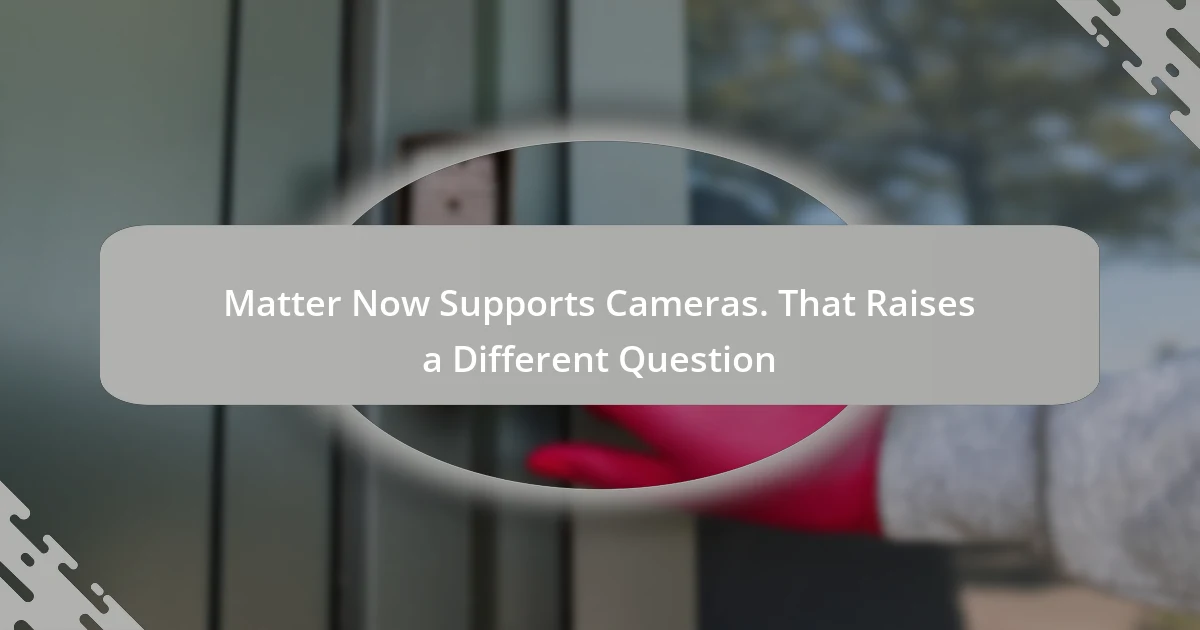
Camera support was the conspicuous absence in Matter for years. Cameras generate continuous high-bandwidth data with real privacy weight, which made them the hardest device class to standardise. That gap has now closed, alongside faster NFC setup, Joint Fabric cross-ecosystem sharing and tighter security requirements.
What changes practically
Until now, a camera bought for one ecosystem was locked to it. Video feeds did not cross platform boundaries, which meant a household running two ecosystems ran two camera apps.
Standardised camera support makes a single view across brands possible. Combined with Joint Fabric, which allows a device to be shared across ecosystems without full re-commissioning, the practical result is that camera choice stops being an ecosystem commitment.
The question standardisation does not answer
Interoperability is about which app can display a feed. It says nothing about where that feed is stored, who can access it, or how long it is retained.
These remain vendor decisions, and they vary enormously:
Local versus cloud recording. A camera that records to local storage keeps footage in the house. One that uploads continuously does not. Both can be Matter certified.
Encryption in transit and at rest. Matter’s tighter security requirements govern the protocol. What a vendor does with video on its own servers is outside that scope.
Retention. Free tiers often keep a few days; paid tiers keep more. Either way the footage exists somewhere you do not control.
Third-party access. Vendor policies on law enforcement requests and data sharing differ, and rarely appear on the box.
The pattern across the standard
This mirrors what happened with locks. TCL’s D2 Pro Matter pairs palm vein recognition with Matter-over-Thread and local control modes — and local control is the specification that determines whether the device keeps working when a vendor’s service does not.
The same distinction applies to cameras, with higher stakes. A lock that loses cloud connectivity fails to open. A camera that uploads to a cloud you have not evaluated is a continuous data flow out of your home.
What to ask before buying
Does it record locally, and does that work without a subscription? Some cameras support local storage only as a paid feature.
What happens to existing footage if you cancel? A worthwhile question that vendors rarely volunteer.
Which ecosystems can see the feed? Matter certification and full feature parity across ecosystems are not the same thing.
Is there a documented security update commitment? A camera is a network-connected device with a lens pointed at your home. An unsupported one is a liability.
The standard has solved the interoperability problem. The privacy question was never a standards problem, and it is still yours to evaluate product by product.