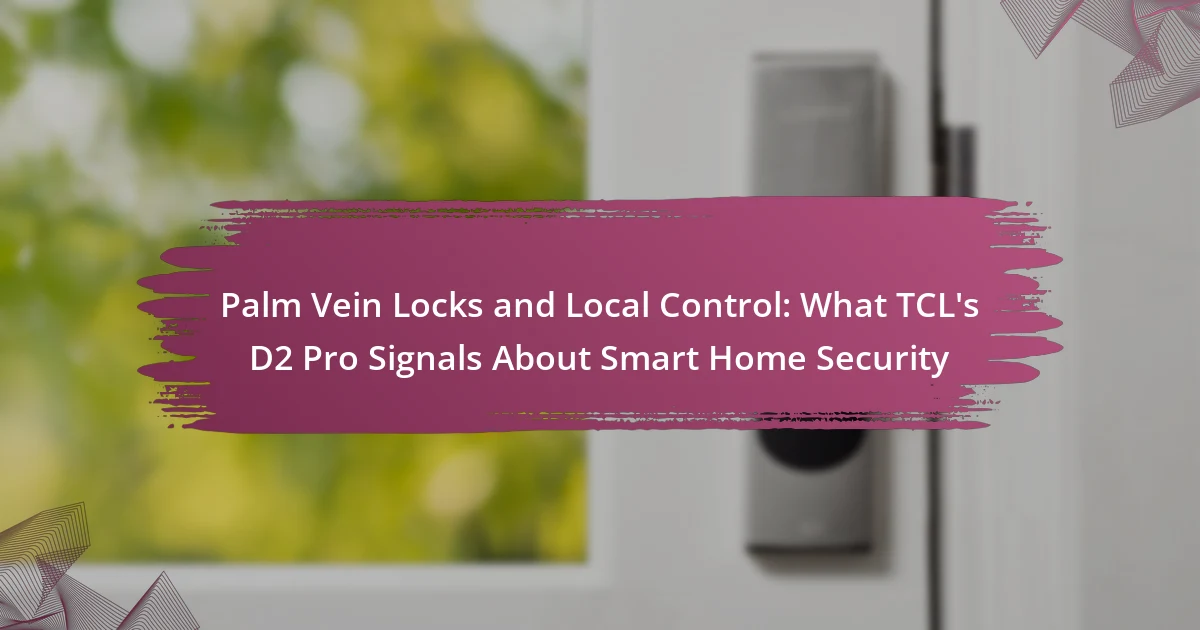
TCL Home Security has launched the D2 Pro Matter, a smart lock priced at $199.99 that pairs contactless palm vein recognition with Matter-over-Thread support and local control modes. The specification list looks unremarkable at first glance. The combination is not, and it is worth unpacking why.
Biometrics moved past the fingerprint
Fingerprint readers have dominated residential smart locks for a decade despite well-known weaknesses. They fail with wet, cold or worn hands, and the sensor surface degrades with weather exposure — a real problem for hardware mounted on an exterior door.
Palm vein recognition reads the vascular pattern beneath the skin rather than a surface ridge pattern. Because the feature being read is subcutaneous, it is not affected by surface contamination the way a fingerprint is, and it cannot be lifted from a touched object. Contactless operation removes the wear problem entirely.
This is not new technology; it has been used in banking and access control for years. What is new is the price. At $199.99 it has entered the range where ordinary households will consider it.
Local control is the specification that matters
The more consequential feature is easy to overlook: local control modes.
A cloud-dependent lock has a failure mode a mechanical lock does not. If the vendor’s service is unavailable, or the household’s connection drops, or the company discontinues the product line, the lock’s smart functions degrade or stop. For a light bulb that is an inconvenience. For the device controlling access to a home it is a design flaw.
Matter-over-Thread with local control means the lock’s core operations execute on the local network. The hub talks to the lock directly — no round trip to a server, no dependency on a vendor staying in business.
This distinction is routinely blurred in marketing. A device can be Matter certified and still route its most useful functions through a vendor cloud. The two claims are separate, and only one of them survives an outage.
Questions worth asking before buying any smart lock
What happens when the internet is down? Ask which functions continue. Manufacturers that engineered for local operation answer precisely. Those that did not answer vaguely.
Where is the biometric template stored? On-device storage in a secure element is meaningfully different from a template held on a vendor server. A biometric cannot be reissued the way a password can, which raises the cost of any breach.
Is there a mechanical fallback? Battery failure is the most common real-world lockout cause, and it has nothing to do with software.
What is the firmware support commitment? A lock is a ten-year purchase. A security device without a stated support window is a liability with a countdown on it.
The wider pattern
The D2 Pro arrives alongside a shift in the standard itself. Matter’s 2026 releases brought tighter security requirements and cross-ecosystem sharing through Joint Fabric, and the certification of safety hardware — Owl Home’s wired smoke and CO alarm has secured Matter 1.5 certification — suggests vendors now trust the standard with categories they previously kept proprietary.
Access control is the logical next category. When a standard is judged safe enough for a smoke alarm, a door lock is not a large additional step. The direction of travel is toward devices that work locally, interoperate across ecosystems, and do not become inert when a company changes strategy.
That is a better default than the industry has offered so far. It is worth checking, product by product, whether a given device actually delivers it.